

Overview
On June 21st, 2018, the United States Supreme Court ruled that South Dakota’s required imposition of sales tax on remote sellers was legal, and overturned a “physical presence” requirement. Part of the Zamp managed service is the automatic monitoring of sales, and registering new economic nexus jurisdictions for accounts when thresholds are met.Key Concepts
Economic Nexus status is handled within a Zamp account, under the Registrations tab. Your platform should not need to maintain registration status internally.Zamp only returns tax when a jurisdiction is added to a client’s account. Until then, zero-tax will be calculated.
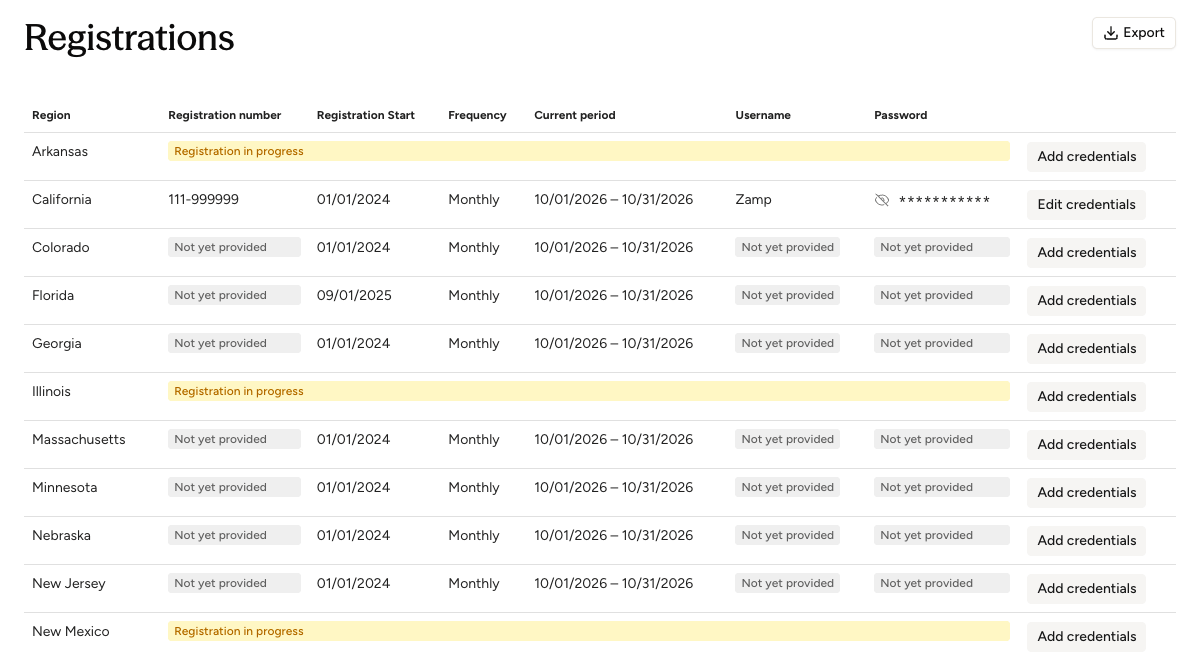
Pre-and-Post Registration
Below highlights the API behavior before and after registration is completed for a jurisdiction.Example
A business is selling into Iowa. It is currently October, and their first month of filing is in November. Therefore the first day where Zamp will return tax is on November 1st.October Transaction
November Transaction
Why Did Zamp Not Return Tax?
If your calculation attempts are not returning tax when expected, keep in mind the following:Timezone
Zamp files sales tax based on the timezone for a given state based on the timezone of the state capital. Example For a state where the central timezone is used for filing and nexus registration, a UTC timestamp of2026-11-01T04:59:00.000Z for a November 1st registration will return zero-tax. This is because that timestamp is 11:59 PM in central-time for the prior day (October 31st in this example).
Ensure you are passing a valid and dynamic timestamp with transactions instead of passing a static time.